Thursday, February 12, 2009

Erik Roland Larsson


In an episode from The Simpsons' golden years, Homer's new boss, the congenial super-villain Hank Scorpio, asks him which country he likes least, Italy or France, before targeting his doomsday device.

Homer shrugs. He picks France.

It was a false choice. The real answer, of course, was Sweden. That self-righteous slice of Scandinavia wedged between the stoically agreeable Norwegians and the delightfully quirky Finns.

Some might say it is just another of my eccentricities-- a vegetarian with minimal affection for animals, a guy who holds the razor in his fingers rather than shave with the stick and who seldom uses shampoo.

My hatred of Sweden cannot be dismissed as eccentricity.

Mind you, I am mostly talking about the Swedish government. I could not be a hater of a people that produced Anita Ekberg, Ingmar Bergman, or the music of ABBA. Wait, I don't care much for ABBA, but that's just a matter of taste.

I am adamant supporter of Swede Sven Goran Eriksson. I am thrilled that the hapless manager has decided to focus his talents for underperfomance on the Mexican national soccer team. Don't let El Tricolor convince you it is your fault, Sven, even if you do manage to bungle their World Cup qualification for 2010.

No, it is not the people. It is the Swedish government I despise. News items like the following are constantly vindicating me on this point.

On May 16th, 2007, Swedish national Erik Roland Larsson was kidnapped from his farm near Tierralta in the department of Cordoba in the north of Colombia. Larsson had worked as an engineer for a Swedish firm commissioned to complete a number of hydroelectric projects in the area. After a finishing a job in Tierralta, the 68 year old man decided he liked where he was and settled down for a happy retirement. Life was good until the morning when eight FARC guerrillas stormed his property and took him hostage.

It's been nearly two years, and still the Swedish government refuses to acknowledge the situation. Before last week the Swedish press hadn't reported the kidnapping. It was only until Larsson's family forwarded photos to the press that they had received from the guerrillas that anyone believed it was possible-- a Swede held hostage by the FARC.


No one understands why the FARC would knowingly hold hostage a citizen of one of its few remaining allies. While the rest of the world has acknowledged that the FARC long ago degenerated into a narco-terrorist outfit, drug traffickers whose hostages act as a human shield and the last bargaining chip with the Colombian government, the Swedish government clings to the line that the FARC is still a legitimate guerrilla movement fighting for social justice. On this point, Hugo Chavez and the Che Guevara T-shirt wearing Swedish public agree. This from the country that booted The United States off the UN Commission on Human Rights in 2001 yet didn't raise concerns over the seating of human rights stalwarts Sierra Leone, Sudan, and Uganda in the same year.

When the Colombian military seized the PC of former FARC leader Raul Reyes in a cross border raid into neighboring Ecuador last year, they found emails on the computer indicating that Sweden had been providing refuge for the guerrilla fighters. This isn't a case of a couple of squadrons sneaking across a porous, jungle cloaked border. The Swedish trips were R'n'R getaways for high ranking kidnapper-murderer-drug lords who flew first class before waltzing through customs and immigration at Stockholm-Arlanda Airport. It was also discovered that the server for the FARC's web page has been operating in Stockholm. The Swedish government also refuses to discuss these issues.

It was embarrassing for Colombia that this news surfaced in a week that saw the liberation of four hostages, the first releases in nearly a year.

Last week the Cordoban newspaper El Meridiano printed an article discussing Sweden's insistence to directly contact the FARC in order to negotiate for Larsson behind the Colombian government's back.


Because neither the FARC nor the Colombian nor Swedish governments will publicly address this curious kidnapping, we don't know the full story. Meanwhile, Roland Larsson languishes in captivity.

The old man doesn't look good. A doctor who saw the video said it appears that Larsson suffered from a stroke. His right arm, leg and parts of his face were paralyzed.

So, for the Homer Simpsons out there who still think France is the enemy, think again. The cheese eating surrender monkeys helped America get her freedom. She gave us a cool statue, taught us how to kiss, to drink wine, and to shrug.

What has Sweden done for you lately?

Update: Larsson released.

Click Here to Read More..

Tuesday, January 27, 2009

People Watching

I promised myself I would not write about politics on this trip. But it´s hard not to think about what's going on in a country that's had an on again off again civil war since the Spanish left. The past five years have seen a dramatic return to peace that no one could have predicted.

I wrote about this transformation last year, the tireless efforts of an executive who refused a conciliatory stance to the guerrillas, about the enthusiasm of the people who could drive on their highways without fear.

Order is probably a better word than peace, human rights groups would argue. The army is everywhere, and the current Pax Romana has had its share of victims. The "false positives" for starters, innocent villagers shot by the military and then claimed to have been guerillas to up the body count in the war against the FARC. President Uribe, who saw unprecedented levels of high support even a year ago, is slipping badly in the polls, perhaps because he is testing the waters for a constitutionaly prohibited third term or because the links to the para-militaries keep surfacing ever higher in his administration. He might also be losing popularity because people have had enough time to take the new security for granted. The problem with a law and order ticket is that once you succeed, the people want to know-- ok, now what next?

In a country where cocaine is the major industry, order from on high will take a constant and tremendous input of energy. This solution will prove impossible without public support. Unless the narcotraffickers are complicit in the order, it is hard to imagine peace can last. To some extent this could be the reality here, who knows and only a fool or suicidal journalist would want to find out. Short of a near simultaneous legalization of cocaine in both producing and consuming countries, the alternatives are sure to be murky compromises.


From a security standpoint a single mafia is less problematic than competing mafias. United States drug enforcement strategy is to go after cartel leadership with the assumption that their substructures will then be unable to function and lose potency. The result been seen a shift to more atomized criminal networks, increasingly the likelihood of a future of competing mafias and a return escalating the violence. That is, once the populace tires of the overwhelming military and security presence that maintains the current order. And the people are getting weary. For the first time in ages, the homicide rates in are pushing back up in the traditional seats of the drug industry.

So, if you´ve had a desire to travel in Colombia, I suggest you visit now before things change again.

¿¿¿¿¿¿¿¿¿¿¿¿¿¿¿¿¿¿¿¿¿¿¿¿¿¿¿¿¿¿¿¿¿¿¿¿¿¿¿¿¿¿¿¿¿¿¿¿¿¿¿¿¿¿¿¿¿¿¿¿¿¿¿¿¿¿¿¿¿¿¿¿¿¿¿¿¿¿¿¿¿¿


A few of chance encounters in country of over 40 million people should not reflect on a country. That would be akin to judging a baseball player on a single at bat. Unless the baseball player's name was Babe Ruth or Barry Bonds, chances are that one at bat is going to make an out. Still, it's fun to people watch.

Chris and I were getting out of a cab at the bus terminal in San Gil when a woman approached us and asked us if we'd like a ride in a car to Bogota. More comfortable, and only 40,000 pesos (the bus is 50,000). We were both a little cautious but she was a good looking woman with long brown hair, a maintained figure and nice skin. She was about our age and was well dressed. She didn´t look like a kidnapper. We dropped our guard when we saw the car, a four wheel SUV with her boyfriend at the wheel. A young couple wanting to pick up some extra cash on the way home from vacation.

I don´t remember much of we talked about. They were not a memorable couple. He had just started a wine importing company, so far the wines were coming from Argentina. She had just opened a store for baby clothes. They were headed to calle 70 in Bogota, the heart of Alto Chapinero, a tony district full of 30 something yuppies. A neighborhood in Bogota where it is safe to walk around at night.

They asked if we needed to stop for anything and I mentioned it would be nice to get a paper for the ride. The conversation turned to the papers in the country and how some were very ideological. I asked what was the best paper, and he naturally replied El Tiempo, Bogota´s nationally circulated, center-right press. But his description of why it was the best paper was the interesting part.

"Because El Tiempo is just the news," he explained. "It doesn't have a political ideology. It is owned by one of the best families in Colombia."

A paper without political ideology? Could it just be that paper shares his politics, the climate that he grew up in, the 'maybe if everyone else will just be reasonable and let the best families do what is right for the country we'll all be better off' ideology?

Politics weren't their game. No worries here, politics make for boring conversations at best with people one hardly knows. But I assumed that this couple would at least be good at being yuppies.

They invited us to have lunch with them at an Italian place near their apartment building. Bogota is one of the few places in Colombia where the food is consistently good, especially if you are willing to pay international prices for high cuisine.

Their restaurant pick had the international prices, a bit unusual for pizza pasta joint. Good pizza is not that hard to come in Colombia, one of the few dishes they consistently do better than in America outside of New York City.

The pizza looked like it had been baked in its glass serving dish. Flotsam and jetsam of vegetables floating in a mess of cheese and runny sauce. I can't say if the crust was tasty or not. The dough had all drifted to one side of the dish and had set like cement. The dish looked expensive so I did not ask for a chisel,

I don't write up the place for its pizza. I would go back for the decor. The walls were covered with blown up photos of the casts of every 1980's American TV show you wish you could forget. The crown jewel was the flat screen behind our table playing a constant stream of 80's New Wave music videos. An altar toVH1's Dada-inspired golden age.

If I had grown up in the projects and only had music videos to know them by, white people would have scared the hell out me. Just type New Wave Music Videos into YouTube and check out the freak show for yourself. Those people were truly creepy. I would love to interview some of the creators of those videos.

If it wasn't for our new acquaintances and that it was Chris' last hours in Colombia, I might have vegged out all day and basked in the decade of my childhood. We asked the couple for some must dos in the city. Maybe one day I'll write up the place they claimed was an obligation, a steak house/disco/vaudeville circus.

¿¿¿¿¿¿¿¿¿¿¿¿¿¿¿¿¿¿¿¿¿¿¿¿¿¿¿¿¿¿¿¿¿¿¿¿¿¿¿¿¿¿¿¿¿¿¿¿¿¿¿¿¿¿¿¿¿¿¿¿¿¿¿¿¿¿¿¿¿¿¿¿¿¿¿¿¿¿¿¿¿¿

Last week I visited an American school. I had met a teacher from the school at the beginning of my trip and he had offered me the chance to observe some of his classes. Teaching at an American school has always been one of those paths I've kept in the back of the mind and I didn't want to pass up the chance to see the reality of a day in the life of a teacher abroad.

Nothing really to report from my observations. A typical k-12 private school. The demeanor in the faculty room suggested a usual range of teachers,some good, a few outstanding, and a couple of real weirdos--more Unabomber than the kind you'd put in a music video.

The high school social studies teacher was a frail and nervous looking man amazingly white for someone living in the tropics. He did not look thrilled with his current life, and was clearly more interested in fruit salad than in making any new friends. But he was my ticket to the high school history classroom, so I did my best to make conversation. After some prompting by my acquaintance, he reluctantly invited me to watch his class the last period of the day.
When I arrived at his classroom at the beginning of the period, the door was locked with no evidence of anyone inside the room. I waited a good 20 minutes, no one showed. It could be he got his schedule wrong, or maybe he just didn't like being observed. No matter, I had my blog to attend to. I went to the teacher lounge and then to the administrative offices and said my thank yous. The school day was almost over by the time I started walking out the main gate.

Past the gate and on the other side of the campus guard house I heard a girl was screaming at the security officer at the end of the school's semi circular driveway. She was standing next to the open door of a new Mercedes sedan that was blocking the end of the drive. She was an attractive girl, maybe 17, though it was hard to notice anything about her besides loud mouth and her alarming breasts. I would later learn it was her brand new Mercedes that her father had given her because the trauma she had suffered the first day back from break when she was suspended from school for hitting a girl. I didn´t ask what offense she had committed to get the over sized implants.

The guard was trying to get her to move the car, forcefully at first, but with less conviction once she started threatening him. I couldn't follow it all, though I can assure you it was nasty. She repeated several times that her father was her boss, and that the poor man was going to be fired. The girl already had her cell phone out and apparently Daddy answered as in a breath she transformed from monstrous bitch to crying little girl.

I had nothing to do, so I figured I might as well take a seat in the shade and watch whatever was unfolding. In less than five minutes Daddy´s Land Rover pulled up to the guardhouse. He was yelling at the security guard through the driver's side window before he was out of the car. The guard waited for an opening and tried to explain his case, that the girl was blocking the drive with her car, but the father cut him off. Meanwhile parents were starting to lineup their cars and a balding man in a white Polo shirt was exiting the front gate. The man stopped a few paces from me to watch what was happening.

The father was threatening the office. Apparently, it was his security company, and how dare he yell at his little girl. The guard pleaded with the man, how were the parents going to pick up their children with a car blocking the driveway´s exit.

"You can figure that out somewhere else," Daddy said. (or at least something like that)

"Excuse me", the balding man said, speaking to the father, "I'm a director of this school. If you fire this man the school will find another security company and your daughter will find a new school."

No one had recognised the man in the white Polo. I learned that he was the school's chairman of the board, and was in a position to follow on his words. The father told his daughter, crying again, to move the car. He made a curt apology to the Chairman, and made a quick exit without so much as a glance at the security guard.


I was lucky to work in a private school with a reputation for reasonable parents and in a public school where at least no one was looking over my shoulder (ever). In the Delta, you had to go looking for the parents, who, if not too cracked out or fall down drunk to speak, would ask you heartbreaking questions like, "Can you tell me what to do with this child?" In both cases there was respect. Even the worst war stories I've heard from other teachers don't come close to those five minutes on the sidewalk outside the American school.

Click Here to Read More..

Thursday, January 22, 2009

Barranquilla Redux


The sign on the wall reads: This facility has public restrooms, please use them. Do not use your own containers.

Where am I?

Well, start with New Orleans. Remove the Quarter, the tourists, the excellent cuisine. Exchange the columned mansions of the Garden District for Moorish villas of Prado Viejo with more bougainvillea. Uproot the Live Oaks, replant Ceiba trees. Pound more cracks into the sidewalks and elevate them at least two feet above street level. Overlay neighborhoods of shotgun shacks with concrete blocks and corrugated roofs. Swap incomprehensible Cajun drawls for incomprehensible Spanish creole. Turn up the heat by day, add a sea breeze (January and February) at night. Refer to Mardi Gras as Carnaval. Get your Yellow Fever jab.

I present you Barranquilla. Another rotting port town beneath the waters of a dirty river.


First, the river. The Magdalena is Colombia's equivalent of the Mississippi and served as the country's primary commercial artery well into the 20th century. Anyone who has read Gabriel Garcia Marquez will be familiar with Magdalena's importance to Colombian history. In the General and his Labyrinth, Simon Bolivar takes his last journey in South America down the Magdalena to his intended exile. The romantic steamboats of Love in the Time of Cholera plied her waters for generations, and the environmental destruction through the deforestation to feed all those wood burning engines is still in evidence. In many places the tropical canopy never returned, rendering one of the river's silted branches unnavigable for commercial vessels. The setting of Chronicle of a Death Foretold was a victim to the river's strangulation. Cut from its commercial function, time stopped in the colonial city of Mompox. It is now a sweltering time capsule of late 19th century life.

A storied, filthy river. But why again Barranquilla?

It's hard to find a town with any interest these days that is off of the gringo trail. Mompox will give you an idea to the extent of the trail's far reaching tentacles. I thought I got off the beaten path for a moment in Mompox last January. Finally a place for that outstanding adventure travel piece I've always wanted to write. But I had no clips to pitch it with, no matter, within days I found scooped by a Harper's article from that February, "Go Before You Die". the piece was about a writer's trip from Bogota to Mompox in what he called the 'New' Colombia, a place where it is safe to travel just about anywhere. Eleven months later even Mompox has become an established outpost on the backpacker trail.

There still aren't any roads that go all the way through to this South American Timbuktu--you get there by a combination of bus, taxi, boat and tuk tuk--but there is a brand new hostel. Not that I would have cared to stew in the staggering humidity of malarial swamps with all the terrifying insects longer than it takes to see the sites. The churches and graveyards are outstanding, but the best visit is to the villa and courtyard that doubles as a retirement home and an insane asylum where blind man Jose Pupo, both old and insane, will take your hand and ask for the year and date of your birth. He'll then tell you about that day in Mompox, in my case a Friday when in rained in the afternoon. Then he'll break out his harmonica and his old and/or insane colleagues will gather around to dance or at least to rock in their chairs to the music.

This can all be done in a day, or in the Harper's writer's case, a morning--he didn't know to look for Jose. Then the reality of the dead river port creeps back with a sunset that brings mosquitoes but no relief from the staggering heat. No, I've logged my year in the Mississippi Delta, thank you very much.

People know about Barranquilla, but they only come here for the four days of Carnaval. Backpacker Bibles The Rough Guide, Footprint, and The Lonely Planet, all write up Barranquilla as a dusty, noisy cauldron of a place without a single permanent tourist attraction.

Excellent work, ladies and gentlemen. Your readers have listened, and stayed away. I didn't know that some of those South African lads could read. But thanks to your descriptions, I am free to roam this town in total obscurity. The people here aren't clued in to what a backpacker is or looks like.

In a city where many people have never met a foreigner outside of Carnaval, people don't know what to make of me when they do notice. Sure, I speak a little funny, too slow for a Costeña, for a coastal person's patience. But then who from out of town doesn't when they pronounce every last little syllable. When I open my mouth what registers in some people's eyes is not so much foreignness as, 'is this guy retarded?' When my mouth is shut I don't look retarded. So I get asked for directions on the street, which is doubly funny in a country where all the cities are on exactly numbered grids. By appearance I'm just another variation of the many European and Middle Eastern immigrants who chose this town when it seemed like it might have had a future.


Those travel writers were on to something. Aside from hosting the second largest Carnaval in South America, Barranquilla hasn't had much going for it in a long time. Not that it doesn't try, in a developing world sort of way. Following the lead of Medellin and Bogota, Barranquilla raised the money for a rapid transit bus line similar to a subway in that it has special lanes and boarding platforms at stations along the route. The mayor promised that the first line would be ready to open at the beginning of 2008 with more to soon follow. One year later and not only is there not a single rapid transit bus on the street, as far as I can tell there is only evidence of one partially completed station along the route. The city did find a way to spend all of the money.

Last summer a local newspaper broke a story that toxic waste dumps had been discovered on vacant sites throughout the poorer districts of the city. The estimated 10 tons of toxic material had been delivered from a consortium of Colombian hospitals, six in Medellin, three in Barranquilla. The companies contracted to dispose of the material had been making easy money on this fraud for as long as 4 years, maybe longer. Health experts are surprised that there don't seem to be any repercussions yet, at least no deaths have been attributed to the dumping. The mayor demanded explanations, as if he weren't already in on the take.

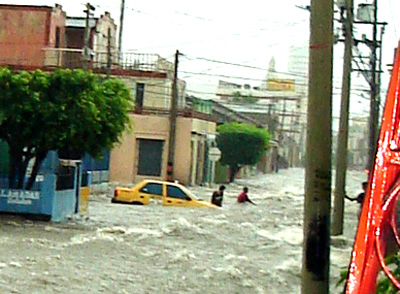
It is slightly less crazy than it sounds, that the perpetrators could have thought they might get away with dumping 20,000 pounds of toxic medical waste in a major metropolitan area, Colombia's 4th largest city. Every summer and fall the slums of Barranquilla function as an above ground sewer. Barranquilla does not have a drainage system, so when the heavy rains come the city streets become rivers, thus the high sidewalks.

The streets whose swift running rivers have rapids are called arroyos. Dogs, children, cars, buses, and the occasional home gets washed away with the arroyos (check out this footage). Since, like New Orleans, the poorest neighborhoods are in the lowest lying and most flood prone neighborhoods, much of the waste dumped there would be expected to wash out into the river each year. It begs the question how much was actually dumped before the waste was discovered. Then again, in a country run by drug lords, what does one expect will happen to a 'waste management' company for dumping some garbage on a city already acknowledged to be shit hole. Perhaps a fine, if the mayor can pocket a piece of that action too.


So I'm here because it's a surreal place to pick up the paper in the morning. I like dysfunctional port towns and the kinds of characters that wash ashore here, or in Barranquilla's case, to sea.

With every year it gets a little more difficult to learn new language. They say the drop is precipitous after the age of 35 or so, and I'm already losing my hearing. So I´m on the clock if I´m ever going to see my goal of fluency in another language. In the next few months I hope to absorb as much as much Spanish as possible. I figure if I can understand the dirty, half-swallowed Costeña Spanish they speak here, I can understand it anywhere. I don't know if I could survive once the breezes stop (late February or March) and I'm not particularly interested in Carnaval, but for the next few weeks Barranquilla will do me just fine.


There is one place I was immediately recognised. Not just as a foreigner, but as an American. I attended Game One of the Colombian Baseball Championships that opened on Saturday. It was a full house, 8,000 capacity in the single deck stadium. A peanut and cigarette man outside the park produced a ticket for me then ushered me to the front of the entrance line.

For 3 bucks I figure i was headed for the cheap seats. Turns out my 'VIP' ticket landed me on the first row in between the plate and 1st base. Like everything in Latin America, the experience was a little louder and took a little louder than the equivalent back home. The crowd cranked their noisemakers and a couple of sections drummed African beats while the organist blasted an amplified truckers horn to rattle the opposing pitcher throughout the 5 hour, 9 inning affair. The 90 cent beers helped to pass the time, as did the old guys behind me who announced the batters and the pitching changes. They took pride in schooling the Yanqui on the nationalities of the players, mostly Colombians.

My local nine has a couple of links to the game here. AA Prospect Jesse English was at one point on the roster of the visiting squad, though I can not find his name on the recent box scores. New Giant Edgar Renteria's foundation sponsors the Colombian baseball league and contributes to the development of Colombian talent. The talent is not overwhelming, thought the mascot was Big League material. The guy dressed up in the gator outfit managed to be the bat boy, field foul balls, chase around kids in the between-inning promotions, and dance to the organ without once tripping over his ground length tail or passing out inside his foam head on a steamy Caribbean night.

Click Here to Read More..

Wednesday, January 14, 2009

Cousins

There is something eerie about a city of 8 million empty of its people. It is Saturday night in Bogota and there isn´t a single car or person on the streets. We are in La Candelaria, the city´s charming if crumbling historic neighborhood that seems more like an outer barrio for students and starving artists than a central district even on a busy night. Only a few hungry dogs are wondering about. It is a heavy quiet, broken only by the odd short bus blasting full speed from nowhere and not even slowing for the dark intersections. How can the middle of a capital city be so empty and depressing?

The barman where we got our last drink warned us to take cabs tonight, and that was in a much posher area of town. This is the weekend of the festival of kings when many smaller towns have their annual fairs. Anyone with family outside Bogota and with the means to leave the city does so this weekend.

But there aren´t even any cabs about in La Candelaria, and no radio taxi is going to drive from across town to take us a block or two to the nearest open corner joint. Maybe the muggers have taken their machetes on holiday too. But it doesn´t matter. A mugging might be better than this claustrophobic hostel.

I´d choose these foreboding streets to Anandamayi tonight. Not that it´s a bad hostel. I´d recommend it as one of the best places to stay in Colombia. The bathrooms are spotless. The dorm where I have been sleeping for the last 5 nights is cavernous, and until Sarah arrived it was me and 11 empty bunks. The floors in the dormitory are dark, shiny hardwood and the ceiling is an A frame that easily reaches twenty feet high. Last year there was a fireplace in the room that they have now removed for fear that some moron like myself would burn the place down. It is cold at night in Bogota, at 2,600 meters it often falls into the 30´s, and last year I would fall asleep right in front of a full on blaze. This trip I´ve had to steal blankets from the empty bunks. With five wool blankets, four up an one down on the mattress for insulation my teeth stop chattering and the cold on my face is a nice contrast to warmth of the bed.

A cold, beautiful place, what looks like a farm house nestled the middle of a national capital. There are two spacious courtyards, one whose every inch is filled with flowers and herbs, the other has poi pond, lush plants, trees, more flowers and benches to sit and read in the afternoon, or at night to huddle under a blanket and contemplate the moon. The kitchen has a wood burning stove and there is always a pot of tea ready for the guests. No fireplaces, but they do have hot water this year, I´m not sure how I stayed in a place so cold without hot water (by taking showers at 2 in the afternoon).

But it is the people here that we have to get away from tonight. Sarah and I had holed up in our empty dorm room but we´ve both seen the shadows of faces as they attempt to peer through the thin curtains that don´t quite cover the windows on the door.

Perhaps I shouldn´t have introduced Sarah as my cousin. That is their interest, in the cousins. It was the only way she could share this beautiful room with me, the young girl in charge this holiday weekend wouldn´t permit friends in the dorm, and she was sure we were more.

It is sort of true that we are cousins. Our stepfathers are brothers.

For the past few days we´ve been getting those sideways glances and rolling eyes from everyone, the staff and especially the Americans, an older would-be businessman and a younger eagle scout type who are both staked out in the warmth of the kitchen. The older American who claims to hail from northern Wisconsin was the model gringo yesterday. Under a Panama hat he smoked cigars in the courtyard all afternoon while pitching a real estate scheme to a middle aged South African. The latter is a happy-go-lucky type who sails catamarans across the ocean for an Australian company. He seems very interested in the American´s scheme. I can only hope he is being polite. I asked the old gringo about his business and he mentioned something about ´flipping´, something else about a four unit complex in Minneapolis, and having been out of the market for three years, before changing the subject. He is full of shit.

The eagle scout is a nice boy. I wonder how long he´ll last teaching in Bogota. He´s acted wounded since the first night Sarah arrived and we went out to the Zona Rosa, the club and nightlife district. I think he has a crush on her, though I do not think Sarah was impressed that out of the hundreds of places he took us to an American styled brew pub and sports bar. Whatever the matter, the whispering begins as soon we leave the room.

So tonight the dark, empty, freezing streets of Bogota are more appealing than the sideways glances and forced conversation in the warm kitchen at the hostel. But what can happen in a block? Surely the bar down the street is open on a Saturday night just past nine.

The cafe is closed. So is the restaurant another block down the hill. Another block and more of the same. I haven´t been too many places where I didn´t feel comfortable walking the streets, but I´m thinking its best we turn back. We take another street to return the hostel and we pass a bodega that is open. There are a few tables and chairs squeezed into the floor space along the counter. Sarah gets some cigarettes. We order beers and a man offers us a table across from the register. We sit and talk a little. A man one table away is staring at us. His eyes are big and bloodshot, but I don´t notice this at first, only that he is smiling. I smile back to be polite. I imagine they don´t get too many foreigners at the tables of this little corner store. He takes my gesture as an invitation and jumps from his seat to one at our table with a suddenness that does not seem natural nor sane. Now I notice the bulging eyes. I´d peg him for a meth addict were we back home. This being Colombia, he is probably just a coke head.

He tells us he is from the poorest barrio in Bogota, apparently the one that sits just above La Candelaria. Sarah knows this type, says there is a guy like at any party in South America, especially one with gringas. She is hardly listening to him. He is focused on her, wants to dance with her, in what space and to what music I do not know. I try to divert him by talk of football, I ask him about the national team. He says something, then repeats himself, again and again, though I can´t understand him, and can´t help but notice his spittle flying from his mouth and into my beer.

A second man at a table nearer the street is interested in us, in a saner, where are we from?, kind of way. He knows about football and we talk a bit, at times over the head of the coke addict who again is focusing on Sarah.

¨She is my cousin,¨ I tell him.

This makes him pause for a minute. Sarah and I begin talking in English. We are enjoying the fact that we may as well be speaking Thai. It is a rare place these days where English can be used as a secret language, but no one here understands a word of what we are saying. The coke head is now grabbing at Sarah. The second man seems embarrassed but says nothing. I tell Sarah in our code that it is time to leave.

A block away and we notice that the coke head is following after us, but he is either too drunk or too blasted to make anything of his pursuit. We stop in front of the first open cafe we´ve seen all night, with what sounds like a live jazz piano, and our friend waddles by us and on up the hill.

The kitchen is empty save for Eduardo, the boy who serves as the night guard, nodded off in front of the television. We sip tea and look through the cards in Class Struggle. I remember this Marxist board game from my last trip here. The box has a picture of Karl Marx arm wrestling one of the Rockefellers. The object of the game is the alliance of the non-ruling classes to overthrow the capitalist system. The professor who wrote the game recommends it as a classroom tool. I must get one of these games for my friend James, I remind myself.

Finally back to the dorm. It would be so much warmer to share a bed tonight, but Sarah is my cousin. Sort of. Click Here to Read More..

Wednesday, November 19, 2008

Hearst Castle, Yellow Journalism, and the Hemp Conspiracy


I took a double take at the herd of zebra grazing in a pasture off the stretch of US 1 north of San Simeon. Then I remembered where I was, a few miles from Hearst Castle. The former estate of William Randolph Hearst used to house one of the most diverse wildlife parks in the world, with over 100 species of grazing animals and 50 types of predator.

The Hearst Castle is now a part of the California State Park system, and for $20 it is possible to take one of five different tours of the estate including an evening tour where local volunteers dress up as guests in period costumes from the 1930’s. The vistas along the 5-mile bus ride up the 1,600 foot rise to the castle’s ridge top setting are nearly worth the price of admission.

William’s father George Hearst purchased the 48,000 acre estate in 1865 for 70 cents per acre. Even at the time this was a discounted price for prime coastal real estate. There was question about the validity of the title based on an old Mexican land grant. As a member of the State Assembly, Hearst sorted out this and other title claims, and the mining baron cemented land holdings that would make him virtual nobility. William acquired these lands upon his mother’s death in 1919, and with the aid of architect Julia Morgan, began a construction of an estate that would remain uncompleted over 28 years and 127 rooms later.

With apologies to Michael Jackson—and his bizarre incorporation of a burn center on his ranch—the Hearst Castle and grounds would have been more aptly named Never-Never Land. Never before and never again could such a house be built.


Prohibitive costs aside, antiquity laws would prevent anything close to Hearst’s fanciful creation. He had entire Renaissance era and Gothic churches dismantled for their intricately carved ceilings, cloisters and choir stalls, though most of these priceless artifacts are easily overlooked amid his world-class collection of tapestries and furnishings from around the world. The façade of the Casa Grande was built to look like a Spanish Cathedral, a fitting style for a host with two strictly enforced rules. His guests were forbidden to bring their own liquor, or sleep with the other guests if not married to them. He was the exception to this rule. The rich and famous flocked to the castle anyway, and the stories along the tour are peppered with the biggest names from the early days of cinema.

The hodgepodge of sacred is contrasted by the motley profane: pools, fountains and gardens with a haphazard mishmash of Greek, Roman, and Egyptian antiquities, and works from Spain and Italy from various periods dating back to the Renaissance.

Our guide included digestible nuggets of the Hearst legend, heavy on the idiosyncrasies of his personal life and his devotion to his mistress, actress Marion Davies, but disappointingly thin on his influence on the world stage. As a historian and journalist I found the omissions of Hearst’s public life a little sad, especially after we were teased with the opening line from our tour guide, “Most of you had probably never heard of William Randolph Hearst before today, in his time he was one of the most powerful men in the world.”

The guide made only passing reference to Hearst’s power, the circulation of his publications reached 30 percent of the American electorate. Not a word on my two favorite Hearst stories, his well-known role in sparking the Spanish-American War, or his recently popularized crusade against marijuana.


The reign of William Randolph Hearst marked a low point in the integrity of the American press. He is credited with the era of yellow journalism, when publisher moguls including Hearst and Joseph Pulitzer engaged in circulation wars by printing sensationalized and fraudulent stories. He directed his newspapers to manufacture sources and quotes that best fit their agendas. Before television, nothing sold newspapers like a war, and when the opportunity arose, Hearst delivered news in a way that made war inevitable.


On February 15th, 1898, the USS Maine blew up in Havana harbor. The warship had been sent to Cuba three weeks earlier in a response aimed at declaring US intentions to protect American citizens amidst an escalating civil war between Spain and Cuban revolutionaries. Though the cause of the explosions aboard the Maine remain unclear to this day, the Hearst papers immediately declared that a Spanish mine had blown up the Maine’s magazines despite the frequency of boiler mishaps aboard the coal fired ships of that day. The New York Journal barked front-page headlines and eight-page spreads denouncing Spanish intrigue in the weeks leading up to the American invasion of Cuba.

That story is now apart of any decent American history survey, not that students read their history textbooks. A lesser known story, though one that has been recently popularized by a spate of books and documentaries about the origin of our country’s drug laws, is Hearst’s relentless crusade against marijuana.

For centuries hemp had been a vital crop for the production of rope, sails, and course fabrics. In the late 1930’s, advances in processing the plant threatened to make hemp a cheap and renewable alternative to paper pulp and allow for mass production of natural hemp fibers. George Schlichten’s new machine, the decorticator, separated the fiber from core of the hemp plant, thereby reducing labor costs and greatly increasing hemp’s fiber yield. Combined with new technology to fashion paper and plastics from hemp-derived cellulose, Schlichten’s machine promised a new direction for the paper and fabric industry.

But what is good for the planet is not necessarily good for the barons of industry. Both Hearst and the Dupont Corporation stood to lose millions of dollars because of the coming hemp revolution. Hearst owned thousands of acres of prime forest and the paper mills that supplied his media empire. Dupont at the time was discovering uses for petroleum-based fabrics including nylon.

To stave of the commercial threat posed by hemp, Hearst began a journalistic crusade against an evil weed from Mexico, marijuana. It would have been impossible to demonize the plant as cannabis or hemp given its centuries long use as a cash crop. Marijuana, on the other hand, was the little known Mexican name for the plant, and Hearst newspapers covered stories of marijuana users incurable hysteria, hopeless dependency and psychotic episodes. The newspaper driven panic against marijuana helped turned public sentiment against the cannabis plant.

Conspiracy buffs note that Harry Anslinger, the drug czar who led the campaign for federal prohibition, was appointed by a Dupont financier. Though the American Medical Association made a stand against the prohibition of a plant with recognized medicinal value, the interest aligned against the fair plant are too strong. In the end, Anslinger coerced the leaders of the medical establishment to change their positions by threats of intense federal scrutiny, paving the way for Marihuana Tax Act of 1937. Hearst is freed to saw his trees and the Dupont to clothe a generation in coal and oil based fibers.

It’s a great story, one that books, movies, and countless internet pundits have popularized in recent years. It pulls the heartstrings of an environmentally conscious audience that would like to believe in a miracle plant that could have saved the world from environmental degradation. Though there may be a grain of truth in the tale, the story that a vast corporate conspiracy was responsible for the cannabis prohibition was pulled from the cloud of a bong hit. Some modern revision of the hemp prohibition rival JFK theories in their asinine complexity, and like Hearst’s best yarns, they seem better suited for the yellow press than serious historical discussion.

The Dupont Corporation’s role in the web does not stand scrutiny. Nylon wasn’t discovered until 1935 and had no commercially patented uses until it appeared in toothbrush bristles in 1938, a year after the Marihuana Tax act of 1937 and six years after marijuana’s inclusion in the Uniform Drug Act of 1932. Nylon was envisioned as a substitute for silk, and did not come viable until demand from the WWII helped it become silk replacement in the early 1940’s.

Schlichten patented his decorticator in 1917, yet there was no corresponding boom in hemp production like the boom in cotton that followed Eli Whitney’s invention of the cotton gin. Perhaps because hemp is not a great clothing alternative, its fibers are coarse and scratchy. Only a conspiracy obsessed, earth-worshipping hippy could stand a hemp wardrobe. Eventually, WWII spurred temporary demand for the production of industrial hemp with full backing of the US government.

Authors and filmmakers would have you believe marijuana was almost completely unknown until Hearst brought it to his readers’ attention in the mid 1930’s. Though it’s true there were very few pot smokers in that time, marijuana was reviled in the press long before the 1930’s, and before the invention the decorticator. Hearst had been waging a campaign against hashish, opiates, and marijuana that spanned the first four decades of the 20th century. Hearst publications were not alone. Articles denouncing the killer weed were also printed in august sources such as The Washington Post—two in March 1905—and The New York Times in January 1901. In 1929, The Denver Post ran a string of articles about the weed after a Mexican man accused of being a marijuana fiend killed his white step-daughter.


The federal laws pursued by Anslinger were only consolidating a prohibition well under way on the state level. Twenty-one states already had marijuana laws in place before the federal regulations of the 1930’s. New York included cannabis on its controlled substances list in 1914. Utah, whose Mormon missionaries returned from Mexico with bundles of the weed, became the first western state to ban cannabis in 1915. Sixteen western states, where the United States’ Mexican population resided, had cannabis bans by 1930. Colorado was late in prohibition, its ban came almost immediately after the 1929 marijuana attributed slaying.

The press on marijuana blamed the drug for the worst stereotypes of a growing Mexican population in the Southwestern US. This fits the pattern of other anti-drug rhetoric from the era, hashish was negatively associated with Middle Easterners, cocaine with southern Blacks, and opiates with Asians. Whether or not racism and xenophobia was the driving force in cannabis prohibition, it was a factor, and almost certainly played a role in Hearst’s news stories. He made no secret of his hatred for Mexicans and Mexican culture.

The best argument in favor of the conspiracy is the curious decision for federal regulators to ban all cannabis production. The smoking weed, cannabis indica, has little in common with the fibrous, tree like cannabis sativa used for industrial purposes. A modern day hemp farmer in Britain illustrates this point with a notice posted on his fence that “it would take a joint the size of a telephone pole for you to you get high,” off the later variety.

Perhaps they weren’t taking any chances. This was after all the era of Prohibition, where alcohol was demonized alongside other mind-altering substances. In that regard the cannabis laws were consistent with the national temperance movement of the day and on the surface less hypocritical than they are today.

Anyway, that’s the Hearst conspiracy and its debunking in a nutshell.

Click Here to Read More..

Wednesday, October 15, 2008

LDS and Prop 8


On occasion I’m willing to break from what my uncle would call the “pinko-liberal” wing of American politics in search of good political solutions. I’d like to think of myself as a pragmatist in the spirit of Peirce and James willing to praise good ideas from wherever they might come.

A new kind of federalism comes to mind. There are compelling arguments for both sides regarding the proper balance of states rights versus federal power in our federalist system. Most of these arguments were anticipated by the founding fathers, so I’ll reduce the matter for brevity’s sake. On one hand, the Civil Rights Era showed that states can be reactionary in the face of needed reform. It took the power of the federal government to break down resistance to integration and the recalcitrance of state institutions. The Civil Rights Era, like the New Deal a generation before it, wed the liberal wing of American politics to idea of federally based policy solutions.

There are compelling arguments in favor of a federalism that respects constitutionally delegated balance of state and federal power. Though generally a conservative position advocated by those in favor of smaller central government, there is also a case to be made that individual states can better tailor initiatives to the specific needs of her citizens. Let the states innovate and become laboratories of policy and let the successes become models for other states and for federal policy.


State ballot initiatives have ushered a new wave of federalism as they blend direct democracy with the latitudes of state innovation. Issues like medical marijuana, affirmative action, gay marriage, assisted suicide, abortion, and animal rights have all found their way on to state ballots for the upcoming election cycle. There are 12 state-wide ballot propositions this year in California alone, a state where successful initiatives are tacked on the State Constitution, and where an unsuccessful proposition, 1994’s Prop 187 against funding for immigrant social services, triggered epic political realignment.

Two of the most contentious measures on California's ballot are negative propositions. Prop 4 (which has failed in two previous elections) would require minors to attain parental consent for abortions. Prop 8 would overturn the State Supreme Court’s ruling on the legality of gay marriage.

Conservatives should have ideological motives to respect this process of state innovation. State initiative on issues like gay marriage would keep the culture wars out of Washington, D.C. Yet interest groups in red states are not content with outcomes in their own states and do not intend to watch Californians decide these issues for themselves. Money is pouring in across the border in an effort to sway Californians on the aforementioned hot-button evangelical issues. The leadership of the LDS church in Utah has mobilized an effort to pass Prop 8 and has raised over $8.4 million for the campaign.

One would think that the LDS, whose control of state politics once made Utah a virtual theocracy that was constantly at odds with officials in Washington, would be inclined to a live and let live attitude for state innovation. This is not the case. The federalist principle is less important to the LDS than the specter of gays mocking their concept of traditional marriage. Let’s overlook for a moment that an LDS marriage is hardly traditional—Mormons do not espouse till death do you part, rather they believe in a union sealed in this life that continues into the afterlife where man and his woman (for a fundamentalist, his women) govern over their own planet in a Mormon solar system—and call this an exercise in political pragmatism. Or is that hypocrisy, I get confused.

Californians have never been known to pass initiatives restrictive of rights, but the polls suggest that the LDS money is starting to turn the electorate in favor of Prop 8. A pity Californians can’t be left alone to figure it out for themselves.
Click Here to Read More..

Wednesday, September 24, 2008

Kriza


The Palestinians at my corner store are proclaiming the end of the American Empire. While I am a bit more agnostic about the state of the times, it is staggering to look back over the excesses, public and private, of the last decade.

A bailout is probably necessary to keep the financial system from freezing up and compounding economic freefall. Any Keynesian worth his salt knows we are best off running up deficits in the bad times. For that to work, however, the theory holds for running surpluses when the economy is good, else the deficits will fuck you. I'm not in this for the accounting, but i suspect if you tally up the domestic pork projects and the IOU's of recent foreign adventurism, you'll find yourself with a number well in excess of the 700 Billion hair of the dog solution to the ongoing financial meltdown.

Oh yeah, and because everyone wants ideas for exotic destinations when they are broke, check out my most recent article. Click Here to Read More..

Friday, September 19, 2008

Harper's Ferry


If you are ever stuck in Northern Virginia with an afternoon free and have any interest in American history, then I highly recommend a day trip to Harper's Ferry. The town is situated at the confluence of the Shenandoah and Potomac rivers, about a 30 minute drive from Leesburg, VA. The town is sited on a bluff that affords impressive views down rivers and the flanking Appalachian foothills. The cobbled main street has been designated part of Harper's Ferry National Park there, and the recreated shop fronts are filled with living history actors. The actor/rangers I spoke with had a commanding knowledge of the history of the town beyond John Brown's raid in 1859. The conviction in his eyes still burns through the lithographs on the museum walls. Though he failed to provoke a slave uprising, the shop attendant/undergrad at the general store will tell anyone who cares to sit and chat awhile about how Brown effectively lit a powder keg under the fraying Differening political responses to the raid splintered the Democratic party of the time paving electoral possibility for Lincoln's united Republicans and hastening the south's preemptive withdrawal from the Union.

I hadn't realized that Harpers Ferry is now a part of West Virginia, the easternmost tip of the state. Long before West Virginia's formation in 1861, there had been a split between the states coastal population dominated by planter elites and the poorer upland dwellers to the west. Though the surrounding area was mostly lowland planter country aligned with the state's slave holding interests, Jefferson County voted to become a part of West Virginia at the 1861 convention. A dyspeptic mill owner did not break character as he explained how, on the day of the vote, federal troops had surrounded the county seat, thereby discouraging the slave holders from casting ballots against withdrawal from secessionist Virginia.


I walked a half mile of the Appalachian Trail from West Virginia across the bridge into Maryland. Might have ventured farther had I brought something other than my dress shoes. I encountered several hikers on my short walk, a couple of whom had come up from Georgia. I'd like to hike the AT one day, maybe like the folks I met who are hiking it in one or two state installments over the course of 8 summers.

Check out my latest travel writing here and here.

Click Here to Read More..

Sunday, September 7, 2008

Four Legs Good


A little over ten years ago, a high school friend took me canoeing on the Harpeth River. We borrowed the canoe from his uncle who has a farm with river frontage out in Williamson County. As we were walking towards the reeds along the shore, a screech came from the trees to the left of us.

Taylor put down the front of canoe. “Come check this out,” he said.

We pushed through the bushy trees and heather to the property of a prominent Nashville family. We reached a clearing with a row of chain link walled huts with A-framed corrugated roofs that I’m reminded of every time I see footage from Guantanamo. The path between the rows of coops gave this place the feel of a miniature village where a single resident perched in each hut. A few sported striking plumage, several with the South Carolina scarlet and black, one had a golden mane. Magnificent birds, sleek and powerful, no pedestrian farm animals these.

“Are they all roosters?” I asked.

“Yup, gamecocks.”

“Isn’t that illegal?”

“In Tennessee it is, they say M_____ and his kid got busted when the cops raided a fight.”


As of this month, cock fighting is illegal in all 50 states. Louisiana had been the last holdout, but the Legislature in Baton Rouge had come under severe pressure from animal rights activists and finally passed a prohibition that went into effect last week.

Given that over 80% of the Louisiana public was against legalized bird fights, the law makes some sense. But the reasons cited by animal rights advocates, that the sport is cruel, barbarous, and violence promoting, are less compelling. If laws are being written for the roosters, then the average American slaughterhouse or chicken factory better look out.

Of all the brutalities of factory farming with its downer cows and killing floors, the chicken factory ranks up there with the worst. The egg hens spend existence in tiny cages pumped full of speed and antibiotics so they’ll grow quicker and not die of horrible infections while stewing in pools of their own chicken shit. Doesn’t sound like much of a life.

The fighting birds I saw were raised in spacious accommodation. We’re not talking dog fighting. Dogs are social animals that must be bred and conditioned through torture to acquire the aggression to fight one another to the death. You don't have to teach roosters to hate each other, just put two of them together and watch what happens. The razor sharp gaffes attached to a gamecock’s legs are another thing, but the blades do make it quicker. Cruelty, sure, but it beats life on the chicken farm.

Not that I'm a supporter of blood sports, mind you. I’m actually a vegetarian. The closest I’ve been to a gaming pit was with Chicken George in Alex Haley’s Roots. If you’ve read the book, you’ll know how much Chicken George loved those birds.

I'm all for the regulation of factory farming if done for the people. The antibiotic consumption is pretty terrifying from a human health standpoint. Constantly dosed populations create fertile environments for the breeding of dangerous drug-resistant bacteria. I realize that low-yield organic farming cannot feed a world of 7 Billion, even if that world could afford to shop at Whole Paycheck, but there's just got to be a better way.

Animal rights pave a slippery slope to nonsense. Take Switzerland, for example, where parliament has enacted a whole raft of new animal protections. Swiss law now requires that your solitary goldfish now have a companion, they are social animals after all. If you own a fish, your aquarium must not be transparent on all sides, because that might be unsettling for them otherwise. And you must ensure them a natural day and night cycle. Don’t even think about flushing Goldie if he’s still alive, you must at least properly euthanize him first.

If you’re the kind of asshole that still enjoys hooking fish out of the lake, no more catch and release. Because that would hurt. And no more live bait, I'm guessing because it's bad for the bait. To get a fishing license, you’ll have to take a course in pesca-compassion. I made up the name; the class exists.

If you want to own a dog in Switzerland, you’ll also have to take a class. The coursework includes five theories on how to best walk it. They don’t want your dog to develop the anxieties that may make him bite someone next time you take him around the block.

It’s not just fish that must be owned in pairs. Any social animal, be it a horse, parrot, hamster, or guinea pig, must now have a companion of like species. Livestock must have “visual contact with their fellows.” It is now illegal to tether your horse or goat, and because your pigs and cows might have sensitive feet, concrete or stone floors are no longer acceptable for their primary dwellings. After rolling around in the mud, Swiss pigs now have the right to take a shower. Mandatory pig showers, now how could I make that up?

Oh yeah, and Swiss Animal Protection, the country’s leading animal rights group, does not believe the legislation goes far enough to protect their friends. They vow to continue the push for four-legged equality.

Doesn’t seem like we could possibly get to goldfish regulation in the United States, but then until recently I thought the Swiss were a reasonable people. So I ask you, faced with the choice of the pet-sitter state, or a few rednecks out in a town you've never heard of killing a few roosters... well?
Click Here to Read More..

Wednesday, August 6, 2008

Chinese Sea Power


The start of the Olympics this week in Beijing has prompted media attention on a range of Chinese issues including Tibet and the Chinese environment, the inexorable rise of the Chinese economy and the increasing influence of Chinese policy on the global stage.

As a global historian and a student in the Western world’s first graduate course on Asian Sea Power, I’d like to take a longer view in this week of China speculation. This week’s focus on the rise of China as a world power, with a few turns of history could have been a tribute to unrivaled Chinese supremacy in the past millenium.

By the year 1000, and for several hundred years beyond, virtually every useful technology in the world had its origin in China. Economic historians of the era like to point out that in the twelfth century, Song China was within “a hair’s breadth” of industrialization. Per capita iron output in China circa 1100 was higher than that of Great Britain in 1700. The densely populated Yangtse Delta was one of the few, if not the only pre-industrialized society to realize intensive economic growth, that is sustained growth in per capita output (as opposed to growth due only to increased population). Various geographical factors, resource constraints including dry and poorly located coal deposits, and the looming twelfth century Mongol invasions, leave us to speculate what could have been in Song China.

In the first decades of the 15th century, as the Italian peninsula was experiencing its Renaissance and the first Portuguese explorers were testing the waters of the North Atlantic, the early Ming empire was laying claim as the greatest seaborne power in the pre-modern world. Nine decades before Columbus set sail across the Atlantic with 300 men in three modest caravels , the Chinese Admiral Zheng He embarked on a series of seven voyages with the intention to incorporate the known world into the tribute system of the Ming empire. Zheng He’s flotillas dwarfed those of his contemporary Iberian mariners. His largest expedition included over 300 ships and 28,000 men, including at least 63 treasure ships that measured 450 feet long and 150 feet wide, a surface area greater than a football field. The Ming treasure ship was largest wooden vessel ever constructed, as a treasure ship’s hull could have accommodated Columbus’s fist expedition as well as the four vessels Da Gama used on his voyage to India.

Zheng He visited Southeast Asia, India, the Middle East, and the east coast of Africa. Though largely discredited, one modern English naval officer and historian Gavin Menzies claims evidence for the eunuch admiral having reached North and South America and even as far as Greenland. In any case, Zheng’s tribute armada must have been an overwhelming site wherever it landed. It helped establish trade routes across the Indian Ocean, and brought the Celestial Empire into the consciousness of most of the known world. Some historians claim that maps from the time of the Zheng expeditions were known to Columbus before he made decision to sail east for China and India.

Then, at the height of Chinese naval supremacy, the Ming court took great pains to cease all Chinese sea trade. At the time of Zheng’s last expedition, a new Emporer decreed a maritime ban in Chinese waters. Sea going trade was punishable with death. All of the empire’s naval records, star charts, route maps, and manuals collected on the imperial expeditions were destroyed by the Chinese minister of war. Some theorize Zheng was considered a threat by the new emperor, others point to the incredible costs of outfitting these expeditions in a time when money was needed to shore up the frontier defenses against the Mongol threat from the north.

Anti-maritime policy was the rule for the next 200 years. In the 1660’s, China’s new Manchu rulers initiated a scorched earth policy along the Chinese coast. They raised coastal towns and villages and forced the seaboard population into the interior. Chinese sea trade persisted in these years only in the southern coastal territories farthest from the Beijing court in the north. The Chinese merchants who established entrepots in Dutch controlled Indonesia and the Spanish dominated Philippines hailed from Fujian and Guangdong (Canton), the two southernmost coastal provinces in China. With this merchant diaspora, Cantonese, and not Mandarin, would become the dominant language of Chinatowns the world over.

By 1840, China had been a dormant naval power for 400 years. When the British East India Company decided to seize ports to distribute its Indian grown opium--the only foreign product it could find with a market demand in China—the Qing state could summon no answer to the steam power and heavy artillery of the British fleet. The Opium Wars humiliated China and began a century of European domination of Asian waters interrupted only by the rise of Japan.

Would China have been so vulnerable if it had not abandoned its sea power? We can only imagine what would have happened if Chinese merchants had been allowed to follow the Zheng expeditions across Indian Ocean, had the Chinese been in a position to rival Portuguese and Muslim traders as the middlemen of the spice trade. The dragon that Napoleon warned the world against had been put to sleep at the height of China’s maritime glory. Click Here to Read More..